Carnatic Masterclass
From Scale Notes to Raga, Phrases, Chords, and Rhythm
This masterclass shows how to move from ordinary guitar scale positions into Carnatic raga playing. The aim is not just to play the right notes. The aim is to convert notes into raga phrases, apply gamakas, understand chord context, and place everything correctly in rhythm.
We begin with the C major scale because most guitarists already know it. From there, we convert the scale into Mayamalavagowla, use it to understand Malahari geethams, move into Mohanam and Hamsadhvani, and finally look at improvisation, chords, tala, and Tillana rhythm.
1. Starting with the C Major Open Position
The open C major scale gives us a useful starting map on the guitar:
C, D, E, F, G, A, B, C
If we take C as Sa, these notes become:
Sa, Ri2, Ga3, Ma1, Pa, Dha2, Ni3, Sa
This is useful because the student can first understand how swaras sit on the fretboard. The same physical notes can be called by western note names or by Carnatic swara names.
2. Converting C Major into Mayamalavagowla
To get C Mayamalavagowla, or the C double harmonic major scale, we change only two notes from C major.
D becomes D flat. A becomes A flat.
So the scale becomes:
C, D flat, E, F, G, A flat, B, C
In swaras:
Sa, Ri1, Ga3, Ma1, Pa, Dha1, Ni3, Sa
The important change is this:
- Ri2 becomes Ri1
- Dha2 becomes Dha1
That is the basic conversion from C major to C Mayamalavagowla.
3. The Problem with Open Strings
In open position, D is on the fourth string open. We cannot flatten an open string by moving one fret back. So we need to find D flat somewhere else.
We can find D flat on the fifth string, fourth fret. Similarly, we need A flat after G.
This gives us the open-position C Mayamalavagowla scale. But there is still a practical problem: Carnatic music needs slides and gamakas. Open strings are not always convenient for that.
4. Turning the Scale into Raga
A scale becomes a raga only when we apply the raga rules.
For Mayamalavagowla, the basic slide ideas are:
- Sa–Ri: D flat slides back to C and returns to D flat
- Ga–Ma–Ga: E, F, E
- Dha–Pa–Dha: A flat, G, A flat
So we are not just playing C, D flat, E, F, G, A flat, B, C. We are giving movement to the notes.
This is the difference between playing scale notes and playing raga phrases.
5. Why Move One Octave Higher
To avoid the limitations of open strings, we can move one octave higher. The third string, fifth fret is also C.
From there, we can again play:
C, D, E, F, G, A, B, C
Then we flatten the second and sixth notes:
C, D flat, E, F, G, A flat, B, C
Now the raga slides become easier. We have more control, more freedom, and more horizontal movement on the fretboard.
This is why learning the same note in more than one place is important. It gives us more options for gamakas, slides, fingering, and phrasing.
6. Using Mayamalavagowla to Play Malahari
The same Mayamalavagowla note positions and slides can be used to play raga Malahari.
Malahari is important because many of the first traditional Carnatic geethams are taught in this raga.
One key point: in Malahari, Ni is usually not used. We go directly to Sa.
So while Mayamalavagowla gives us the parent scale map, Malahari gives us the first practical raga phrases and geethams.
7. Lambodara Geetham
The first Malahari geetham is Lambodara, also known as Sri Ganadha.
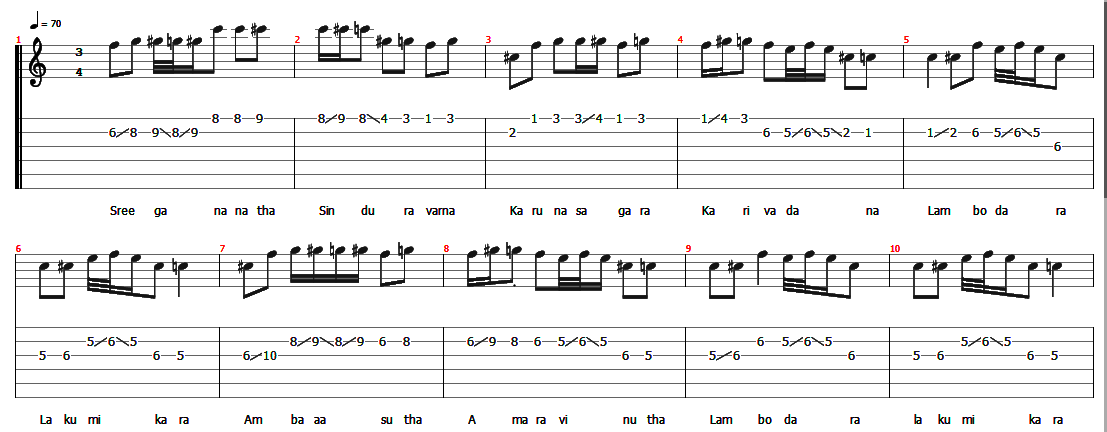
Using simple slides, we can convert the C Mayamalavagowla scale into the first Malahari geetham.
8. Mapping Swaras Clearly
The fretboard map is important because Carnatic music has more than one Ri, Ga, Ma, Dha, and Ni.
In C major:
C = Sa D = Ri2 E = Ga3 F = Ma1 G = Pa A = Dha2 B = Ni3
In C Mayamalavagowla:
C = Sa D flat = Ri1 E = Ga3 F = Ma1 G = Pa A flat = Dha1 B = Ni3
So the student must understand both the note name and the swara name. Otherwise, it is easy to get lost when moving between western scale maps and Carnatic raga maps.
9. Moving Beyond the Beginner Version
In the next Malahari geethams, we use longer slides and more embellishments.
For example:
Pa, Dha, Ma, Na, Pa
Ga, Ma, Na, Pa
Pa, Ga, Re, Ma, Ma, Pa, Sa, Dha
Here we are no longer only playing basic swara slides. We are moving closer to performance.
Repeated notes also get emphasis. For example, when Dha or Ma repeats, the second repeated note can receive emphasis from the previous note.
The Ri can be played as a Ga–Sa–Ri slide. This creates a more authentic phrase sound than simply playing the note directly.
10. Learn Raga at Phrase Level
Raga has to be learned and improvised at phrase level.
Scale notes are only the raw material. The raga identity comes from phrases, slides, emphasis, and movement.
In Malahari, many phrases repeat across the first three geethams. These become the core phrases of the raga.
The fourth Malahari geetham, Padmanabha, uses more phrases and is slightly different. But by learning the first three geethams, we already learn many important Malahari phrases.
These phrases can then be mixed and matched for improvisation.
11. Finding Chords from Raga Phrases
Chords should not be chosen only from the scale. I prefer to choose chords from the phrase.
Take the notes in the phrase. Then ask: which chord gives these notes a good context without clashing?
For example, if a phrase uses D flat and A flat, we may think of D flat major or D flat major seventh.
For Ri–Sa–Dha, D flat major seventh can work.
For Ma–Ga–Ri, we may try A major, F major, or A7 depending on the phrase and the color we want.
Sometimes I may choose F minor or C minor even if it is not strictly inside the C double harmonic major scale. The reason is feel and color.
So chords are not just theory. They are arrangement choices.
12. Chords for Mohanam
For raga Mohanam, the phrase may contain E and G. Then C major or E minor can work.
If G, A, and C occur together, A minor 7 can work.
If C, D, and E occur together, C add9 can work.
The method is simple:
- reduce the phrase to its component notes
- check which chord contains or supports those notes
- avoid clashes unless the style allows them
- choose the color based on genre, audience, and arrangement
There are no fixed “Carnatic chords” by themselves. We are placing chords for a Carnatic melody.
13. Raga Mohanam
Raga Mohanam is one of the important early ragas in Carnatic geethams.
It is roughly based on the major pentatonic scale:
Sa, Ri, Ga, Pa, Dha, Sa
But if we play only the plain pentatonic scale, it does not sound Indian. We need to add the raga slides.
Because slides are difficult in open position, we move again to the third string, fifth fret position.
The ascent and descent rules are not always the same. When going toward Dha in ascent, we may start from Pa, go to a higher note, and rest on Dha. But when descending from Sa to Dha, the movement can be different.
This is why raga cannot be reduced to a scale formula alone.
14. Fingering and Phrasing Optimization
When playing phrases like ga ga pa pa, fingering matters.
The first Ga may be plain. The second Ga may get an emphasis slide. Pa may be placed in a position that allows us to move quickly to Sa.
So while learning raga rules and note positions, we are also learning fingering and phrasing optimization.
The student should not memorize every move only as tablature. It is better to memorize the swara sheet and then apply phrasing logic.
For example:
Ga Ga Pa Pa
Dha Pa Sa Sa
Then we add the needed gamakas according to the raga and the performance level.
15. How Much Embellishment to Use
The amount of embellishment depends on the stage of the student.
A beginner may first play a simpler version. Later, the same phrase can receive more gamakas, longer slides, and stronger note emphasis.
The goal is not to decorate randomly. The goal is to move closer to the raga’s natural phrase logic.
When the raga slides are applied correctly, even a simple geetham starts sounding authentic.
16. Improvisation Starts with Phrases
To improvise in raga, start with phrase-level material, not scale running.
Major-scale-based ragas are a good starting point. Mohanam comes from the major pentatonic scale. Hamsadhvani is another pentatonic raga, but it uses Ni3 instead of Dha2.
But this is still only scale information. Authentic improvisation needs phrase information.
We learn phrases from compositions, varnams, muktayi swaras, and chittaswaras. These phrases show us how the raga actually moves.
17. Hamsadhvani Improvisation
Hamsadhvani is based on a pentatonic major scale with major seventh instead of major sixth.
For example, if we take D as Sa, the raga uses the notes that create the Hamsadhvani sound.
The important thing is to learn small phrases and stay with them.
There is no need to hurry. There is no need to use many notes.
Even with two or three notes, we can begin improvisation.
Slow down. Stay there. Use the same notes in different phrase combinations.
Being able to stay with four notes, such as Pa, Ni, Re, and Ga, and still improvise musically is an important raga skill.
18. Chords for Hamsadhvani
Hamsadhvani has Sa, Ri, Ga, Pa, Ni.
If we take D as Sa, the raga contains the major second and the major seventh.
So D major seventh is already useful. If we add the major second, we get a D major ninth sound.
D major ninth contains many of the differentiating notes of Hamsadhvani.
Other chords can also work, such as A major or F sharp minor, because they belong to the D major scale family.
Specialized colors can include:
- D major seventh
- D add9
- D major ninth
- suspended chords
- D suspended two
The idea is not to force one chord. The idea is to use chords that support the raga phrase and give the arrangement the right color.
19. Underlying Competencies in Learning Compositions
When learning compositions like Vatapi, geethams, varnams, or Tillanas, we should also understand the underlying competencies.
The first competency is knowing which scale notes are used and which are not used.
The second competency is applying the raga rules, not merely playing the notes.
The third competency is rhythm.
A composition is not just melody. The phrases must sit correctly inside the tala.
20. Rhythm in Geethams
Lambodara has a repeating unit of six.
Sri Gananaada can be felt as two plus four:
Sri Gananaada Sindhura Varna Karuna Sagara Kari Vadana
The consonants sit on the repeating unit. That creates rhythmic stability.
In Kereya Neeranu, the rhythm can be understood as:
1, 2, 3, 1, 2, 3, 4
In Chatushra Jati Triputa Talam, we may count:
1, 2, 3, 1, 2, 1, 2
The swaras and consonants must sit properly inside these units. Otherwise, the rhythm becomes unstable.
21. Tala, Speed, and Internal Counting
In Adi Talam, we normally count eight:
1, 2, 3, 4, 5, 6, 7, 8
But in performance, the melody may move at double or four-times speed compared to the tala.
So the student must learn to feel the tala position while singing or playing faster phrases.
This takes skill. It is not enough to know the notes. We must also know where the notes fall.
22. Tillana and Rhythmic Precision
In Tillana, the main difficulty is often not the notes alone. It is rhythm placement.
We need to know:
- where the phrase starts
- where the phrase ends
- where the gap is left
- where the gap is not left
- how the phrase returns to the downbeat
The arithmetic must work. Otherwise, we may play the phrase but fail to return correctly to the song.
For Tillana, we should practice the rhythm even without the guitar. We can say the consonants and feel the gaps.
This helps us understand where to hurry, where to slow down, and where the phrase joins back.
23. The Full Learning Path
This is the full path shown in the masterclass:
- Start from a known guitar scale position.
- Map western notes to Carnatic swaras.
- Convert the required notes to get the raga scale.
- Apply slides and gamakas to turn the scale into raga.
- Learn geethams as phrase collections.
- Understand repeated raga phrases.
- Use phrases for improvisation.
- Find chords from phrase notes, not only from the scale.
- Practice rhythm, tala, and phrase placement.
- Move from beginner versions toward performance versions.
The main idea is simple: Carnatic guitar is not just scale playing. It is note mapping, raga movement, phrase memory, gamaka control, chord context, and rhythmic placement working together.
That is how a scale becomes music.
